If My Baby Only Contact Naps or Feeds to Sleep, How Will Nursery Manage?
"But she only falls asleep fed, or held, or lying on me. How on earth is nursery going to manage that?"
It's one of the most common things parents say to me before nursery starts, and underneath the practical question is usually a quieter, harder one:
Have I made things too difficult? Have I created something that only works because it's me?
Someone's probably already told you, gently or not, that your baby will "just have to learn" once nursery starts. And somewhere in the back of your mind, you might already be counting the weeks of leave you've got left, wondering if that's enough time to change how your baby falls asleep before you're back at work.
I want to offer you something different.
Feeding to sleep and contact napping aren't a problem nursery is about to expose, and they're not a countdown you need to beat before your leave runs out. They're a normal, biologically intelligent way your baby has learned to feel safe enough to sleep, with you specifically.
Nursery starting doesn't put that to the test, and it doesn't come with a deadline attached. It just means your baby is about to learn something else entirely: that different people, in different places, can help in different ways, and none of it threatens what you've built together
It's Not About Undoing What You've Built

The worry makes complete sense. You've spent months figuring out exactly what helps your baby settle, feeding them to sleep, holding them through a nap, lying beside them, whatever it is that actually works. Then nursery arrives, and it can feel like you're about to find out whether all of that was "real" settling or just a habit that's been propping things up.
It was never propping anything up.
A baby who feeds or is held to sleep isn't missing a skill. They're using the tools available to them, with the person they trust most, in the place they feel safest. That's exactly how sleep is supposed to work for a baby this age. Nothing about nursery starting changes what's true about your relationship or what your baby needs from you at home. The two are not in competition.
There's No Countdown to Beat
If you've caught yourself doing the maths, working out exactly how many weeks of leave are left and whether that's enough time to change how your baby falls asleep before you're back at work, I want to gently stop you there.
There is no deadline.
Nursery does not require your baby to arrive already falling asleep independently, and there is no version of "ready" you need to engineer before your return-to-work date. That pressure is entirely manufactured, usually by advice that assumes every baby needs to be taught to self-settle before childcare, when in reality plenty of babies who feed or are held to sleep at home go on to nap perfectly well at nursery without any of that groundwork happening first.
Spending your last few weeks of leave trying to unpick something that currently works, under time pressure, with a deadline hanging over it, is one of the hardest possible conditions to make a change in even if you wanted to. It asks you to do difficult, emotionally loaded work while also trying to enjoy the time you have left with your baby before returning to work.
You don't need to do that.
This was never a relay where one thing has to finish before the other can start. Feeding to sleep or holding your baby at home and something entirely different happening with their key person at nursery can both be true at the same time, for as long as that's what works, with no handover date attached.
Babies Are Better at This Than We Give Them Credit For
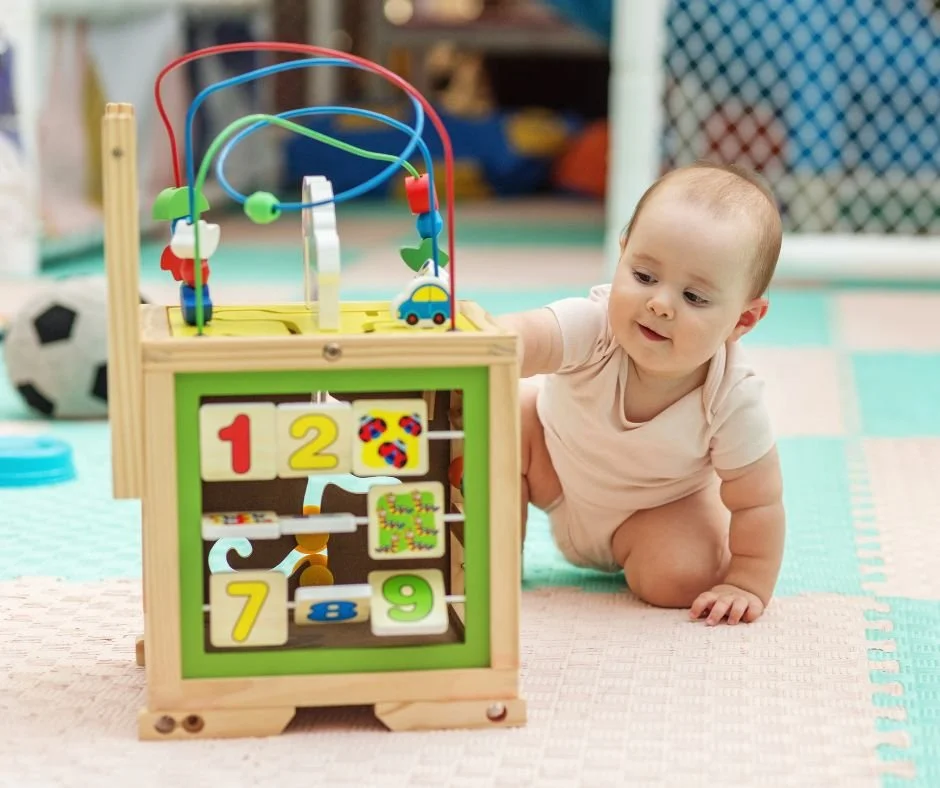
Here's the part that tends to bring the most relief. Babies are remarkably capable of holding different expectations for different people, without any of it causing confusion or distress.
Think about how naturally this already happens. Grandma might do bedtime completely differently to you, and your baby doesn't wake up the next day expecting Grandma's version from you. A baby who's fed to sleep by mum might settle differently for dad, who can't offer the same thing. None of this unravels anything.
Babies read context. They know who's holding them, where they are, and what that person can offer, and they adjust accordingly, not because they're forced to, but because that's how a young nervous system is designed to work.
Nursery is the same principle at a bigger scale. Your baby's key person can't replicate feeding to sleep, and probably can't hold your baby through an entire nap the way you might at home either. That's fine. Your baby isn't expecting them to. What they're actually looking for from their key person isn't a copy of you, it's a different source of safety that belongs to that relationship and that place. It doesn't have to look the same to work
Yes, Naps May Still Go a Bit Rogue for a While, and That's Fine
It’s very likely that naps at nursery are very likely to be short, patchy, or missing altogether for the first while, and that has almost nothing to do with feeding to sleep or contact napping specifically.
Nursery rooms are brighter and busier than a nap space at home, because staff need to be able to see and hear every child. Everyone else's nap schedule is happening around your baby's. A brand new environment, with unfamiliar sounds and a routine still bedding in, is simply a harder place to switch off than home, whoever's doing the settling.
Nursery naps are often the last thing to properly even out, sometimes taking a good few weeks even though your baby seems very content in the setting. That's not about how your baby falls asleep. It's simply what a brand new environment does to sleep, for any baby
The Herd Effect: Why a Room Full of Sleeping Babies Actually Helps
There's something else working quietly in your baby's favour that has nothing to do with feeding or holding at all.
Humans evolved sleeping in groups. For most of our history, sleeping alongside others wasn't a comfort, it was survival, a way of sharing the risk of a vulnerable state. Some researchers who study sleep from an evolutionary angle describe this as a kind of social shelter, the idea that a sleeping group offers real safety that a lone sleeper doesn't have.
That instinct hasn't gone anywhere. It's part of why a room full of other babies dozing off, even without a single feed or cuddle in sight, can really help a baby's nervous system settle. There's a kind of safety in numbers that doesn't rely on your baby's usual settling method at all, because it's tapping into something much older than any routine.
It won't replace what you offer at home, and it isn't supposed to. But it's one more reason nursery napping isn't the uphill battle it might feel like on paper
Why It Might Not Feel the Same, and Why That's Okay

Your baby's key person can build real, warm, trusted connection with your baby. It matters, and it helps. But it isn't the same intensity of bond as the one your baby has with you, and it doesn't need to be for nursery to work.
That difference cuts both ways, and neither direction means anything's wrong. Sometimes a baby settles more easily for a key person precisely because the emotional charge is lower, there's less big feeling attached to the moment, so less to regulate before sleep can happen.
Other times a baby takes longer to trust a new person enough to let go into sleep with them, which simply reflects how strong the bond with you already is. Neither pattern is a problem to solve. They're both completely normal responses to a completely new relationship.
If your baby is the type who fights sleep at the best of times because they don't want to miss a moment of what's going on, why does my baby fight sleep? The truth about FOMO babies goes deeper into that pattern specifically, and a room full of nursery activity is exactly the kind of place it tends to show up.
What Actually Helps
Don't try to wean feeding to sleep or contact naps before nursery starts
There's no need to "prepare" your baby by changing what already works at home. The two settings don't need to match, and there's no deadline attached to your remaining leave.
Spend your last weeks of leave with your baby, not troubleshooting a problem that doesn't exist
If part of you has been treating this time as a countdown to "fix" sleep before returning to work, it's worth naming that pressure and setting it down. It was never a requirement.
Tell their key person what actually helps your baby, not just their schedule
Whether they need to be held, patted, or just know someone's nearby, that information helps far more than a nap time on a form.
Let the key person find their own way, rather than trying to recreate yours
They can't feed your baby to sleep, and that's fine. Give them room to build something that works between the two of them, even if it looks nothing like what happens at home.
Expect the first few weeks to be unpredictable
Some days will go far better than others, and that's not a sign of a plan failing. It's what adjusting to somewhere new looks like.
Keep doing exactly what you do at home
Feeding to sleep, holding, contact naps, none of it needs to change because nursery is now part of the picture. Your baby is fully capable of holding both.
Ask for a simple update at pickup, not a verdict
"She napped for twenty minutes after some rocking" tells you far more, and feels far less loaded, than "she wouldn't settle." Nursery staff are usually happy to describe what they tried rather than mark it as a win or a loss.
Nothing About This Undoes What You've Built
If you're lying awake worrying that nursery is somehow going to reveal a problem with how your baby sleeps, I want you to hear this clearly: there isn't one. Feeding to sleep, holding, contact napping, all of it is exactly the kind of responsive care a baby this age needs, and none of it becomes less true because someone else is now also caring for your baby part of the week.
Nursery napping will likely take its own path, messier at first, easier with time, helped along by things that have nothing to do with what happens at home. Your baby is capable of holding two different, equally real ways of being cared for, without either one cancelling the other out. What you've built together stays exactly as it was.
If you'd like to understand your baby's temperament and how it shapes moments like this one, why standard sleep advice doesn't always work for sensitive babies goes deeper into that. And if contact napping itself is something you're still working out, my baby will only sleep on me, is that a problem? covers exactly that question.
Want to Understand Your Baby's Sleep More Clearly?
If this has helped settle some of the worry, there are a few ways I can support you further:
Free resources. Head to my free resources page for guides and tools you can use straight away, at no cost.
The Baby Sleep Builder. If you want a fuller, structured framework for understanding your baby's sleep, the Baby Sleep Builder walks you through it at your own pace.
A Sleep Clarity Call. If you'd rather talk it through properly, a Sleep Clarity Call gives you sixty minutes of focused, one-to-one support built around your baby specifically. Book a Sleep Clarity Call here.
Frequently Asked Questions
Do I need to stop feeding my baby to sleep or contact napping before they start nursery?
No. There's nothing to prepare or wean beforehand. Nursery doesn't need your baby to arrive already self-settling, and trying to change something that works at home right before a big transition usually adds pressure without any real benefit.
Do I need to change how my baby falls asleep before I go back to work?
No, and there's no deadline to work towards. It's easy to start treating the end of maternity leave as a countdown to change how your baby sleeps before nursery, but nursery doesn't require that groundwork, and trying to make a change under that kind of time pressure tends to be harder on everyone than simply letting nursery be where something new begins in its own time.
Will my baby stop wanting to be fed or held to sleep at home if nursery settles them differently?
Very unlikely. Babies are very good at holding different expectations for different people and places. What happens with their key person at nursery doesn't overwrite what happens with you at home.
Why does my baby settle fine at nursery but still want to be fed or held to sleep at home?
This is common and isn't a contradiction. Your baby is responding to who's with them and where they are, not applying one fixed rule everywhere. Different context, different needs, both completely valid at the same time.
Is it normal for nursery naps to look completely different from naps at home?
Yes. Nursery rooms are busier and brighter than most home nap spaces, and settling to sleep in a new environment takes time regardless of how a baby usually falls asleep. Short or patchy naps at first reflect the newness of the setting, not a problem with feeding to sleep or contact napping.
Will nursery think I've created a bad habit by feeding or holding my baby to sleep?
A good nursery won't frame it that way. Responsive settling is completely normal, and key people are used to working with all kinds of sleep preferences. Sharing what helps your baby, rather than apologising for it, will build the best relationships.
How do I explain my baby's sleep cues to their key person?
Keep it specific and practical: what settling looks like, what helps, and what to expect if it doesn't go smoothly. Most nurseries welcome this, since it helps them support your baby faster rather than working it out from scratch.