Do I Have to Sleep Train at 4 Months? What's Really Going On With Your Baby's Sleep
Maybe it happened overnight. One week your baby was sleeping in longer stretches, and the next they're waking every 45 minutes, fighting bedtime, and needing you more than they have in weeks.
Or maybe there was no before. Your baby has never really settled for long, and four months has simply arrived as the point where everyone around you seems to expect that to change.
Either way, someone has probably already said the word to you. Regression. Maybe a friend, a forum, your own mother. And with that word usually comes the next one: sleep training. As though four months is some kind of deadline, and if you don't act now, you'll be dealing with this forever.
You're tired enough to wonder if they're right.
They're not. What's happening to your baby's sleep right now has a real biological explanation, and it isn't a sign that anything's gone wrong, least of all the way you're currently getting your baby to sleep.
Why This Age Feels Like a Turning Point

Four months sits at an odd crossroads. It's early enough that your baby is still deeply dependent on you for comfort and safety, but it's also exactly when the sleep training industry tends to target parents hardest, because it's exactly when sleep really does become harder for biological reasons.
That timing isn't a coincidence, and it isn't proof that something has gone wrong with how you've been doing things. It's proof that your baby's brain is maturing on schedule.
If you want the full picture of what's changing in your baby's sleep architecture at this age, the shift from two sleep stages to four, and why that means more waking rather than less, I've written about the biology of the four-month sleep shift here. This blog is about the question that usually follows once a parent understands that: does knowing the biology mean I now have to do something about it?
The Pressure to "Fix It Now"
A lot of what's written for parents at this stage isn't really about supporting your baby's development. It's designed to funnel exhausted parents toward a training programme, using fear as the lever. Miss this window, the messaging implies, and you'll be paying for it in a year, or five.
That fear is doing a lot of work it hasn't earned.
There is no window that closes. Babies whose parents keep responding to them at four months go on to sleep well. Nothing about staying responsive during this stage locks in a permanent pattern of poor sleep.
Training doesn't speed up neurology. This shift resolves as your baby's brain finishes adjusting to its new architecture, not because of what happens at bedtime. However you respond to your baby right now, their sleep cycles are going to keep maturing at the pace they're going to mature at.
Feeding to sleep, rocking, contact naps, and safe bed sharing aren't the problem. They're not bad habits quietly sabotaging your baby's sleep, and you don't need to unpick them to get through this phase. If it's working for your family, that's reason enough to keep doing it. If you're finding yourself questioning your own confidence around all of this rather than just the sleep itself, my blog on how to feel more confident about baby sleep without sleep training or guilt goes into that side of it directly.
So What Actually Changes at Four Months?
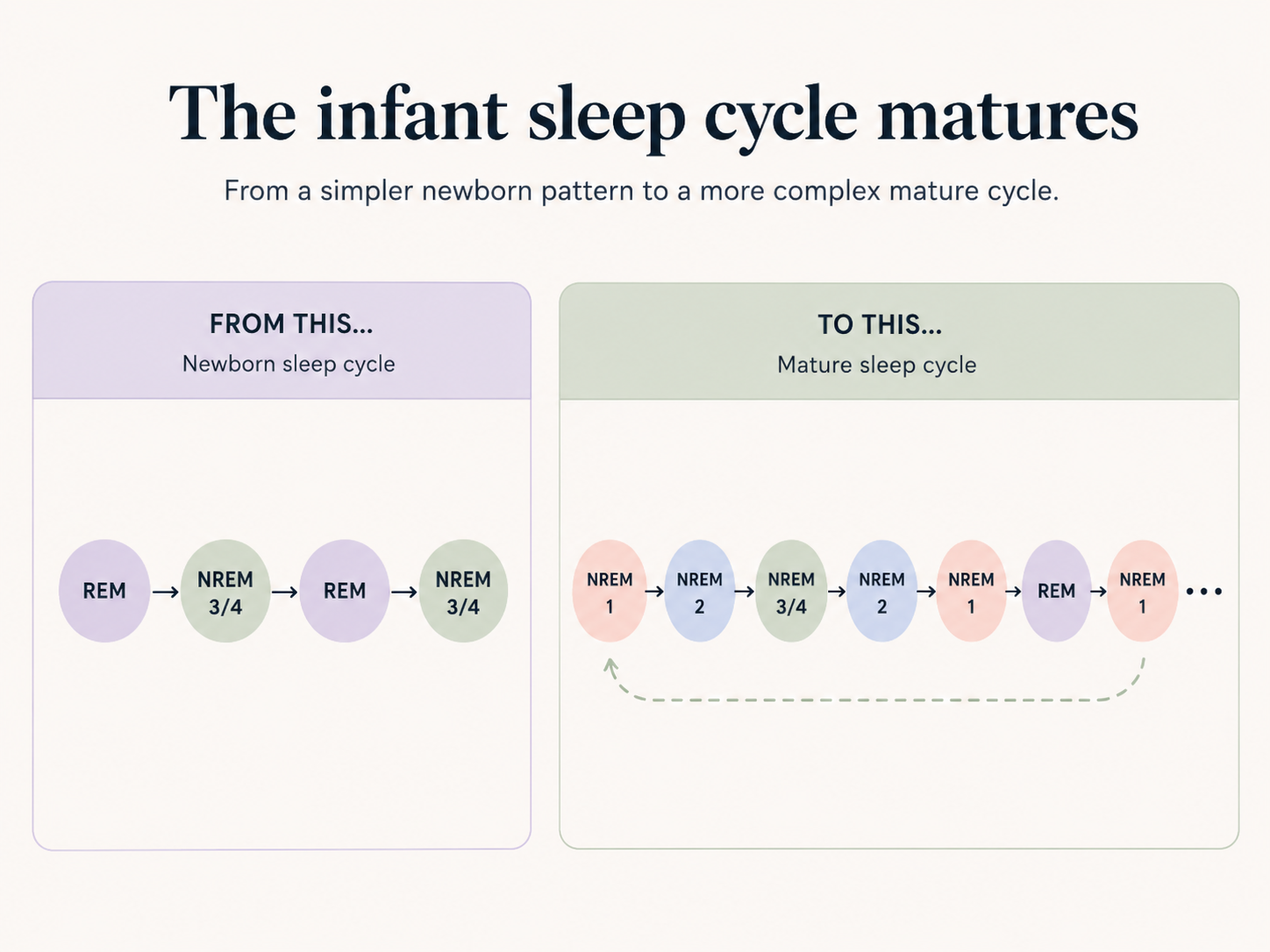
Nothing about what your baby needs from you changes. What changes is how often they're likely to wake and ask for it.
Your baby's sleep is becoming more like an adult's, with more transitions between sleep stages throughout the night. In the early months, sleep runs on just two stages, active and quiet, and it's fairly disorganised. From around three to six months, that shifts to four stages, much closer to adult sleep, and each cycle now runs about 40 to 50 minutes. Every one of those transitions is a small chance to wake fully rather than drift back under.
That's the whole story behind the waking, the false starts, and the shorter naps. It isn't a problem that's appeared. It's a more mature brain, doing exactly what a more mature brain does. If your baby is waking closer to every hour than every 45 minutes, that's still well within what's biologically normal at this stage, and I've written more on that here.
Some babies barely notice this shift. Others feel it far more deeply, particularly babies who are especially alert and tuned in to everything around them. If that sounds like yours, that sensitivity isn't something gone wrong either. It's temperament, and it's frequently the same trait that makes for a wonderfully curious, empathetic child later on.
What Actually Helps Right Now
The honest answer is: less change, more support.
The middle of a developmental sleep shift is the worst possible time to overhaul how your baby falls asleep. Loosening your own expectations, protecting whatever is already working, and getting your own rest wherever you can will take you further than any new routine will.
Protect what's already working
If feeding, rocking, or holding your baby to sleep is getting you both through the night, that's not a habit to break mid-shift. It's the thing holding things together while everything else recalibrates.
Lower the bar for the next few weeks
This isn't the season for a new sleep plan, a new schedule, or a new anything. It's the season for getting through.
Watch for overwhelm, not just tiredness
Exhaustion is expected here. But if you're finding it hard to function day to day, feeling low or anxious beyond what feels proportionate to broken sleep, or you simply feel like you're carrying this alone, that's worth talking to someone about, whether that's another adult in the house, a friend, or your GP. Struggling with the emotional weight of this stage is common, and asking for support isn't a sign you're failing to cope with something you should be managing alone.
I've put together a full, free guide that walks through exactly what to do during this stage, hour by hour: how to work with your baby's sleep pressure rather than fight it, how to keep resettles calm, how to protect your rest as a family, and what might need a professional's eye versus what's simply a phase to move through together.
Want the Full Guide to Getting Through This?
Download The 4 Month Sleep Regression, Rethought Here - Free
This guide walks you through exactly what's happening in your baby's brain, what actually helps day to day, and why you don't have to sleep train your way out of it. It's the guide I wish every exhausted parent found at 2am instead of another countdown timer.
If you've read this and recognised your own baby as one of the ones who feels everything more deeply, The Sensitive Baby Sleep Companion goes much further into how temperament shapes sleep and how to work with it.
And if you'd rather talk it through with someone who can look at your specific baby, my Sleep Clarity Call is a 60-minute session built around exactly that.
Frequently Asked Questions
Do I have to sleep train at four months?
No. There's no biological deadline that requires sleep training at this age. The four-month sleep shift happens whether or not you change how your baby falls asleep, and staying responsive doesn't create a pattern you'll be stuck with later.
Will feeding or rocking my baby to sleep make this phase worse?
No. Feeding, rocking, and contact naps aren't causing the increased waking. The waking is coming from your baby's sleep cycles maturing, not from how they fall asleep.
How long does the four-month sleep shift last?
It varies by baby, but it typically eases within a matter of weeks as your baby's sleep architecture settles into its new, more mature pattern. Wobbles along the way are normal.
Is it normal for my baby to wake more at four months even though nothing else has changed?
Yes, this is one of the most common patterns at this age. Nothing needs to have gone wrong in your routine for waking to increase, it's simply part of this developmental stage.
My baby seems to be struggling more than other babies I hear about. Is that normal?
Yes. Some babies are more sensitive to change and stimulation than others, and this stage can hit them harder. That's temperament, not a sign that you're doing something wrong.