How Much Sleep Does My Baby Need by Age?
There's a moment most parents recognise. You look up a sleep chart, count the hours, and feel something sink. Because your baby doesn't quite match. And a number that was supposed to reassure you ends up doing the opposite.
So here's something that tends to get lost in those moments: those charts describe averages drawn from large groups of babies. They were never written with your baby in mind. And when your baby doesn't match, that says a great deal more about the limitations of the chart than it does about your baby.
This guide walks you through how much sleep is typical at each age, from newborn through to five years, what those figures actually mean, and, more importantly, how to tell whether your baby is getting enough sleep without turning it into something to stress over.
How much sleep does a baby need in 24 hours?

Babies need somewhere between 8 and 18 hours of sleep across 24 hours in the first year. Yes, a large a range as that!
That total includes both daytime naps and night sleep. How it splits across the day and night can vary far more than most charts suggest, and both ends of that range can be entirely normal for an individual child.
Baby sleep needs by age
Below is a guide to average sleep by age, including naps and night sleep from newborn through to five years. It's designed to give you a sense of the bigger picture, not something your baby needs to match exactly.
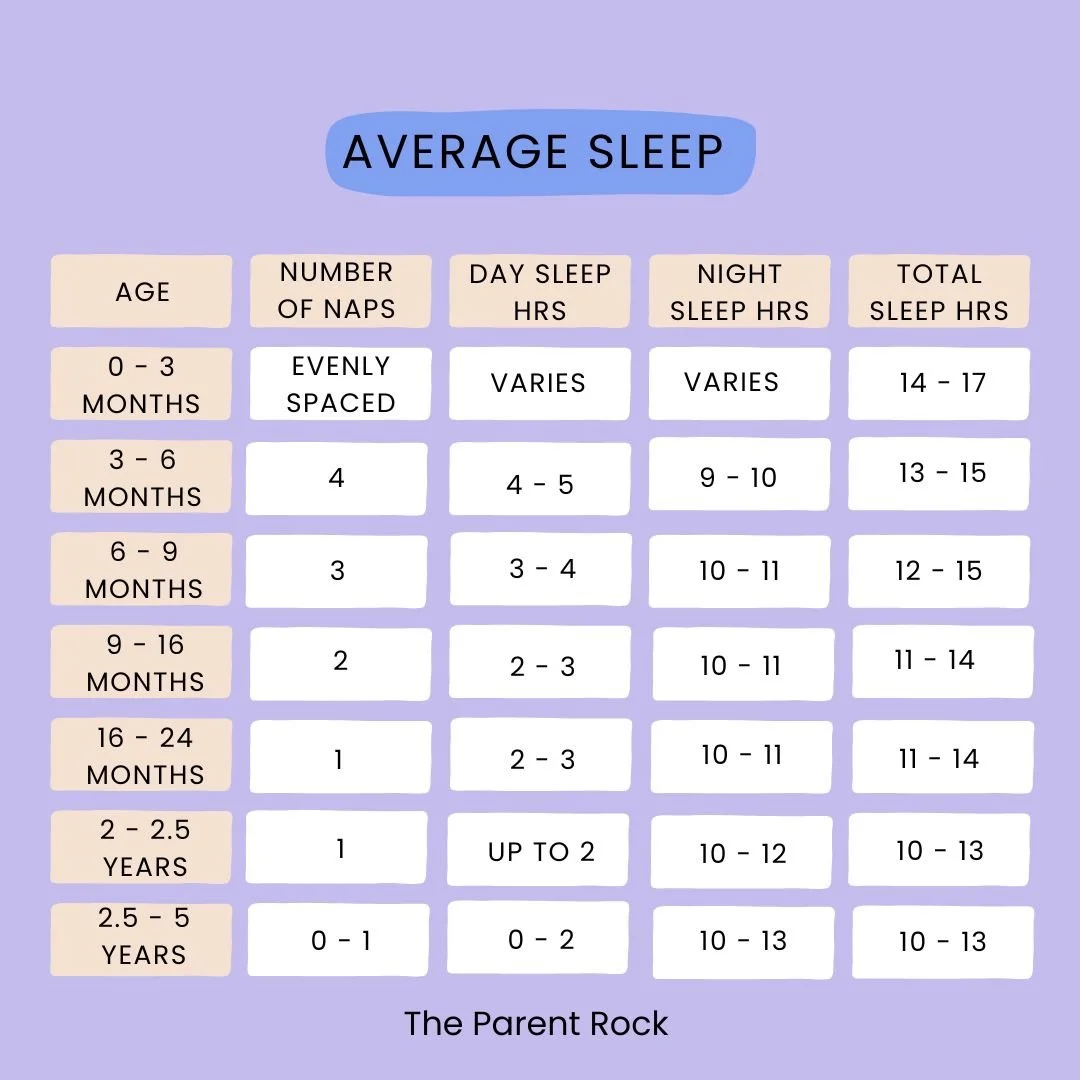
What baby sleep charts don't tell you
This is the part that tends to get lost.
These figures describe a range of what's typical, not a set of targets your baby is supposed to hit. When you're already tired and looking for something to hold on to, it's very easy to quietly turn that range into an expectation. To start measuring your baby against it, wondering where they fall short.
But your baby isn't an average drawn from a large group. They are one individual child, with their own temperament, their own nervous system, and their own way of regulating. Their sleep is shaped by all of that - not just their age.
Understanding that is often the first thing that makes the numbers feel a little less heavy.
Why your baby's sleep might look different from the average

When a baby's sleep doesn't match the charts, there's usually a very ordinary explanation behind it.
Some babies simply need less sleep than others. Some need more. Some distribute their sleep differently across the day and night in a way that doesn't line up neatly with what you might have expected.
Quite often, what looks like "not enough sleep" on paper is simply sleep being arranged differently. A baby might have shorter naps but still seem settled and content, or slightly less night sleep but more during the day. When you step back and look at the full 24 hours, it often makes far more sense than it first appeared.
Nap patterns are one of the most misunderstood pieces of this bigger picture - if that's something you're trying to make sense of, this post on how many naps your baby should have by age explains the biology behind daytime sleep and what's actually typical at each stage.
Does my baby need to sleep 12 hours at night?

This is probably the most persistent expectation in baby sleep, and one that creates a lot of unnecessary pressure.
The idea that babies should sleep 12 hours overnight is everywhere. It sounds like a reasonable goal. But for most babies, it simply isn't biologically typical.
For a large number of babies and toddlers, somewhere between 9 and 11 hours overnight is entirely normal. When a child is gently nudged towards more night sleep than their body is ready for, it can start to show up in ways that feel frustrating - early waking, unsettled nights, or long stretches of wakefulness in the small hours.
Not because anything has gone wrong. But because the expectation and the biology are slightly out of step with each other.
If you're trying to work out where bedtime fits into all of this, my post on what time your baby should go to bed explains how total sleep across 24 hours affects the night, and why pushing bedtime earlier doesn't always lead to better sleep.
How do I know if my baby is getting enough sleep?

This is usually the question sitting underneath all the others.
And it's one a chart genuinely can't answer.
What gives you a clearer picture is looking at your baby as a whole. How they are across the day. Whether they're able to engage, play, and connect. How they cope in the time between sleeps. How they settle with your support.
A baby who is generally content and able to move through their day is very unlikely to be missing something essential, even if their sleep looks nothing like the textbook version.
If you're wondering whether your baby is genuinely sleep-deprived or simply waking more than you'd like, this post on whether your baby is really sleep-deprived is worth a read. It unpacks what sleep deprivation in babies actually looks like, and why frequent waking usually isn't the same thing.
Why watching the clock can make sleep feel harder
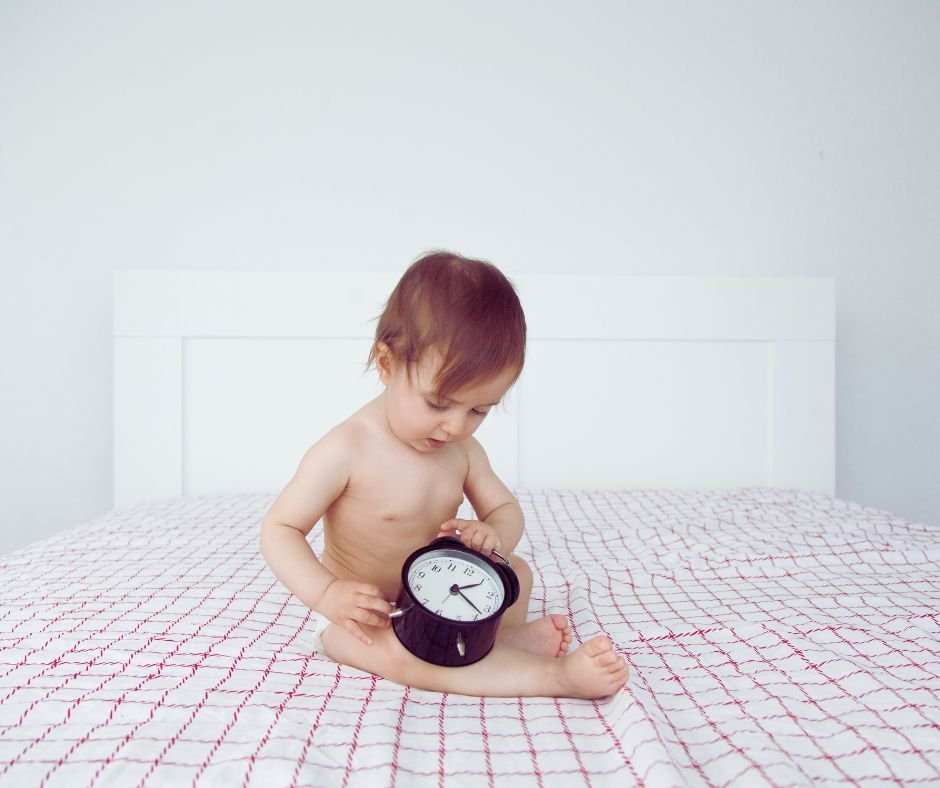
When sleep becomes about hitting a certain number of hours, it's very easy to end up watching the clock more than your baby. Adjusting things constantly. Second-guessing decisions. Searching for the exact combination that will finally make everything click.
Sleep doesn’t tend to settle well under that kind of scrutiny.
It's shaped by sleep pressure building gradually across the day, by your baby's body clock, by how sleep is spread across the full 24 hours, and by what helps them feel calm enough to fall asleep in the first place. When you begin to understand those pieces, the numbers start to matter less, and your instincts start to feel a lot more reliable.
What to do if your baby's sleep doesn't match the chart

If you're reading this because something feels off, it's very rarely as simple as your baby needing more sleep overall.
More often, it's about looking at the bigger picture. How sleep is distributed across the day and night. Whether bedtime is sitting in the right place. How naps are timed. Whether the overall rhythm is working with your child's natural patterns rather than against them.
Small, thoughtful adjustments here tend to go much further than trying to chase a perfect total.
Sleep charts can be a useful starting point. But they're not rules, and they're not a measure of how well you're doing.
Your baby is not a number on a chart. They are a whole small person, shaped by temperament, development, and the particular way their nervous system works. What they need most isn't to match an average. It's simply to be understood.
And that's already something you're doing, just by asking the question.
Want to understand your baby's sleep better?
If you're reading this and thinking, this makes sense, but I still don't quite know what to shift - that's exactly where a little extra support can make things feel clearer.
A good place to start is my free gentle sleep guide - it's free to download and shares the calm, connection-first approach I return to again and again with the families I work with.
If you'd like something more personalised, the Baby Sleep Builder is a step-by-step tool that helps you build a gentle sleep rhythm that actually fits your baby and your life - without rigid routines or sleep training.
And if you'd like one-to-one support, my sleep packages look at your child as a whole - their sleep, their temperament, your days, and what feels genuinely manageable for you - and gently shape things in a way that fits your family. No pressure. No rigid rules. Just calm, realistic support that helps you understand what's going on and what to do next.
Frequently asked questions about baby sleep needs by age
How much sleep does my baby need by age?
Sleep needs vary by age - babies need anywhere between 8 and 18 hours across a 24 hour period. These are ranges, not exact targets, and individual babies can sit comfortably outside them and still be well-rested.
How many hours should a baby sleep in 24 hours?
This depends on age and on the individual child. Some babies naturally sit at the lower end of the range and are content, thriving, and developmentally on track. Total sleep across the full day and night matters more than how neatly it divides between day and night.
Is it normal for my baby to sleep less than average?
Yes. Sleep needs vary considerably between babies. A baby who is generally content, responsive, and developing well is usually getting what they need, even if their sleep looks different from the averages on a chart.
Should my baby be sleeping 12 hours at night?
Most probably not. Many babies and toddlers sleep closer to 9 to 11 hours overnight, which is entirely typical. The 12-hour overnight expectation is widespread but not biologically accurate for most babies, and pushing towards it can quite often make nights harder, not easier.
How do I know if my baby is overtired?
"Overtired" is actually a bit of a misleading term - you can't really be too tired to sleep. What's actually happening when a baby seems wired, hard to settle, or fussier than usual before sleep is nervous system dysregulation. They've been awake longer than their system can comfortably manage, and a dysregulated nervous system finds it genuinely harder to wind down, however tired the body is.
You might notice this as increased fussiness or clinginess in the lead-up to sleep, with difficulty settling despite obvious tiredness.
What happens if my baby doesn't get enough sleep?
The honest answer is that healthy babies are remarkably good at getting the sleep they actually need - and true sleep deprivation in babies is far less common than the sleep industry would have you believe. Frequent night waking is biologically normal, and a baby who wakes often overnight isn't necessarily missing sleep; they're often simply taking it in smaller pieces.
What you might notice if your baby's overall sleep rhythm genuinely isn't working for them is harder-to-read mood across the day, less ability to engage and play, or difficulty settling at sleep times. But a baby who is growing well, connecting with you, and moving through their day with reasonable contentment is almost certainly getting what they need - even if the nights feel relentless from where you're standing.